







When you order Japanese Pokémon cards from Japan, you pay VAT, and since 2026 also customs duty and an EU handling fee even on small orders, usually plus a fee to the carrier. From a shop inside the EU, VAT is included in the price and there is nothing more to pay at the door. Below we go through each charge, how Norway differs and why the shop matters more than the fees. For the bigger picture, see our complete guide to Japanese Pokémon cards.
What you pay when you order from Japan
All goods bought from outside the EU have carried VAT since 1 July 2021, whatever their value. You pay your own country's rate, for example 25% in Denmark and Sweden, 19% in Germany and 21% in the Netherlands, and it is calculated on the price of the cards plus shipping, duty and the EU handling fee.
Until July 2026, parcels worth €150 or less were free of customs duty. Since 1 July 2026, they pay a flat customs duty of €3 per item, under a temporary EU rule that runs until 1 July 2028. An item is not each card or pack but each kind of goods in the parcel: goods with the same tariff classification, description and origin count as one item. Five identical booster packs are therefore one item, while a booster box and a pack of card sleeves are two.
On top of that, an EU handling fee of €2 per item has applied since 1 November 2026 to goods sold online from outside the EU, whatever their value, and it is not refunded if you return the goods. Above €150, normal duty applies instead of the €3: for trading cards at most 2.7% of the value. Cards of Japanese origin can come in at 0% under the EU–Japan trade agreement if the origin is documented and claimed at customs, which also removes the €3 on smaller parcels, unless the shop uses IOSS.
Shops in the EU's IOSS scheme, which covers orders up to €150, charge the VAT at checkout. Whatever the shop has not collected, the carrier pays at the border and collects from you before you get the parcel, together with a fee of its own. In Denmark, PostNord charges 225 kroner for this on a parcel with one item, and Deutsche Post in Germany €7.50 (November 2026).
This is how the routes compare:
| Charge | From Japan, up to €150 | From Japan, over €150 | From a shop in the EU |
|---|---|---|---|
| VAT | At checkout (IOSS) or on delivery | Usually on delivery | Included in the price |
| Customs duty | €3 per item, as a rule | At most 2.7%, or 0% with proof of Japanese origin | None |
| EU handling fee | €2 per item | €2 per item | None |
| Carrier fee | If anything is collected on delivery | Usually | None |
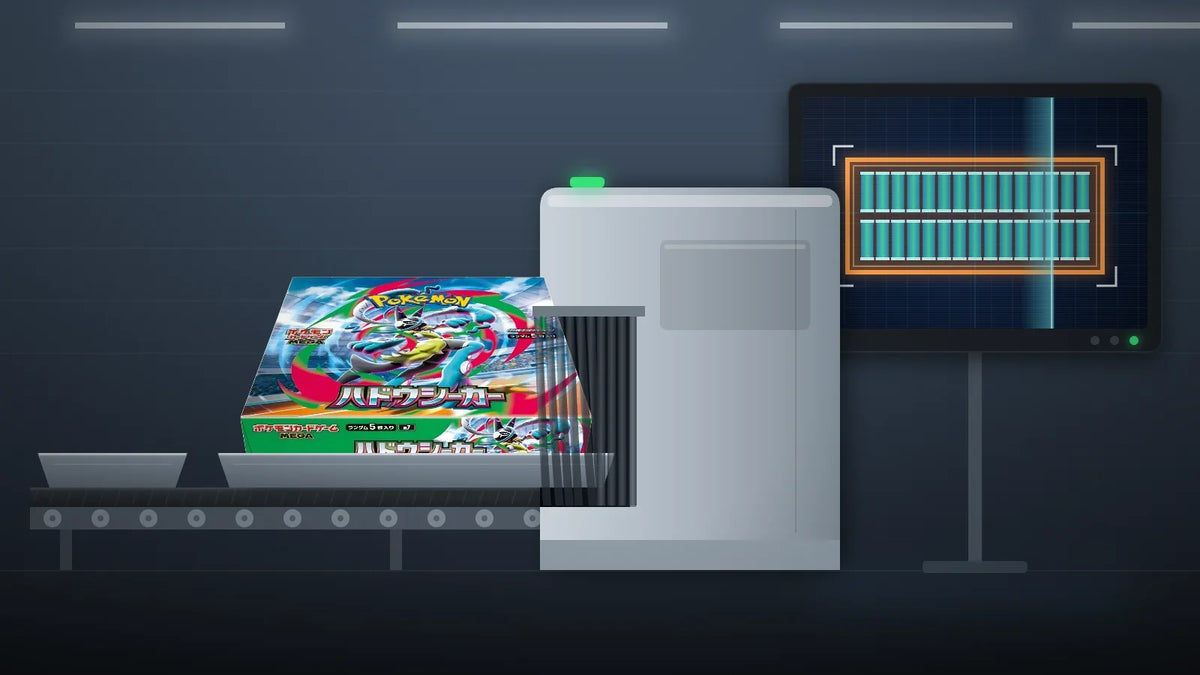
The drawing shows the difference: a parcel from Japan stops at customs (1), and the carrier adds its fee before delivery (2), while a parcel from a shop in the EU comes straight to you (3). That only holds if the goods are sent from inside the EU. A shop with a European address that ships from outside the EU leaves you with the same charges. If you collect Chinese cards, parcels from China are treated the same way, as our complete guide to Chinese Pokémon cards explains.

Norway: VAT at checkout or on delivery
Norway is not in the EU, so the EU duty and handling fee do not apply there, but Norwegian VAT does. Since 1 January 2024, it has been due on all goods bought from abroad, whatever their value. Shops registered in the Norwegian VOEC scheme charge it at checkout on goods worth less than NOK 3,000 per item. Otherwise you pay VAT and any duty when the goods arrive in Norway, and the carrier can charge a fee for clearing them.
We are registered in VOEC ourselves, so on goods under NOK 3,000 you pay the Norwegian VAT at checkout, and there is nothing more to pay when the parcel arrives.
Is it cheaper to buy straight from Japan?
Sometimes, but compare the full price. On a parcel under €150 with two different items sent to Denmark, the duty and the EU handling fee alone come to €10. Then 25% VAT is added to the cards, the shipping and those charges, and if PostNord collects anything on delivery, its fee comes on top.
Popular new sets can also be hard to get at the Japanese price. When the MEGA expansion pack Abyss Eye (M5) came out on 22 May 2026, one of the official Pokémon stores in Japan only sold it through a prior lottery, with a limit of 10 packs per person. So a box sold far below the usual price deserves a second look.
Where the shop is also matters if something goes wrong. With a shop in the EU, you have 14 days to cancel online purchases from the day you receive them and at least two years to complain about faults, while the Danish Competition and Consumer Authority warns that enforcing your rights against a shop outside the EU is far harder, and sometimes impossible.
Why the shop matters more than the fees
Counterfeit Pokémon cards are not only a flea market problem. In May 2026, Dutch customs found more than 1.7 million counterfeit Pokémon cards in a shipping container in the port of Rotterdam. In Spain, police seized half a million counterfeit products in 2023, mainly Pokémon cards, which had been supplied to shops to be sold alongside genuine products, and in 2024 more than 75,000 counterfeit Pokémon cards were seized from businesses in the centre of Rimini in Italy.
Denmark is no exception: the Danish consumer council Forbrugerrådet Tænk warns that counterfeit goods also turn up in Danish shops. Resealed boxes are harder to document, but we see them too. We hear from collectors who have bought resealed boxes from shops in Denmark and elsewhere in the EU, usually because the price was lower than everywhere else, and in our experience it is the most sought-after boxes that get resealed. Customs have told us that fake and resealed goods typically come from China, but that they also come in from Singapore and Japan, so a box sent from Japan is no guarantee in itself. Our guide to buying Chinese Pokémon cards in Europe covers what to watch for with cards from China.
A shop does not have to know that it is selling a fake or a resealed box: a box that has passed through several hands can have been tampered with on the way, and a good reseal looks right at first glance. So the question is not only whether a shop is honest, but whether it knows where its boxes come from.
A shop you can trust:
- buys straight from distributors and wholesalers, or knows exactly where its stock comes from
- says clearly when a box is sold without shrink
- shows its company name, address and VAT number
- is covered by EU consumer rules
- prices popular boxes in line with the market, not far below everyone else
That is how we work. Much of our Japanese stock comes straight from distributors and wholesalers in Japan, and we have compared factory shrink from several sources, so we know what a genuine seal looks like. When a box has no shrink, it says so clearly on the product. We ship from Denmark with VAT included in the price, so in the EU there is nothing more to pay at the door. The Storm Emeralda (M6) and Ninja Spinner (M4) packs below are from our stock.


- 100% authentic sealed products
- Shipped within 1–2 business days
- Full refund within 14 days of delivery
- Shipping from €27,95
How to check a box yourself is covered in our guide to spotting a resealed or fake Japanese booster box, and what a missing film means in our guide to shrink vs. no shrink Japanese booster boxes.
See the products
To open lots of packs

Pokémon Trading Card Game
Aura Seeker/Hadou Seeker (M7) - Booster Box (Japanese)
Frequently asked questions
Do I pay customs duty on Japanese Pokémon cards?
As a rule, yes. Since 1 July 2026, parcels from outside the EU worth €150 or less pay a flat €3 per item. Above €150, normal duty applies: at most 2.7% for trading cards, or 0% with proof of Japanese origin. On top comes an EU handling fee of €2 per item.
Do I pay VAT when I buy from Japan?
Yes, always, at your own country's rate and on the full amount including shipping, duty and fees. Either the shop charges it at checkout, or the carrier collects it before delivery.
What counts as one item?
Goods in the parcel with the same tariff classification, description and origin, so five identical booster packs are one item.
Is it cheaper to buy Japanese cards from Japan?
Not always. Add shipping, VAT, duty, the EU handling fee and the carrier's fee before you compare.
How do I know if a shop is safe?
Look for one that buys from distributors or wholesalers, shows its company details and VAT number, and does not sell popular boxes far below the market price.
 5,95
 2,95
 3,95
 83,95