









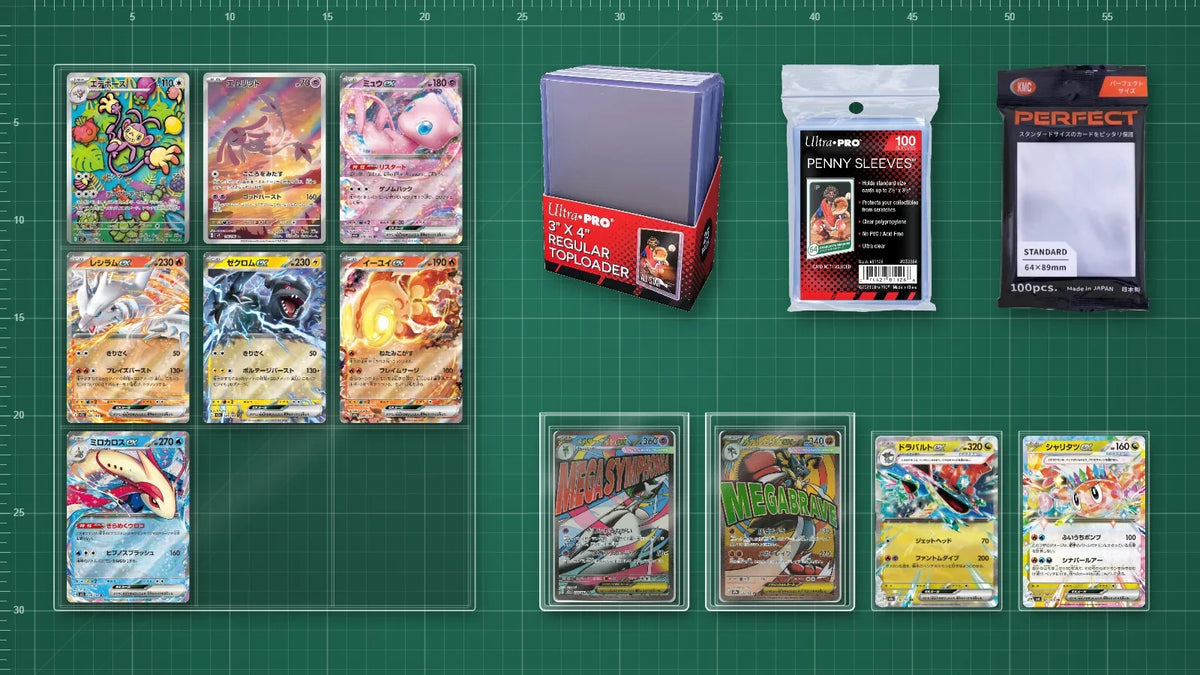
Put every card you want to keep in a penny sleeve, give your best cards a toploader, and keep the rest in a binder or a storage box somewhere cool, dry and dark. That simple routine protects against scratches, bent corners, dust and damp, and it works the same for Japanese and English cards. New to Japanese cards? Our complete guide to Japanese Pokémon cards covers the basics.
Which protection for which card
Not every card needs the same protection. This is the setup we recommend:
| Protection | What it is | Use it for |
|---|---|---|
| Penny sleeve | A thin, soft plastic sleeve | Every card you want to keep |
| Perfect fit sleeve | A tight inner sleeve, 64 × 89 mm | Binder pockets and double sleeving |
| Toploader | A rigid holder, 3 × 4 inches | Your best cards and cards you send by post |
| Binder | Pages with 9 pockets on each side | Sets you are completing and cards you like to look at |
| Storage box | A cardboard box with rows | Bulk, duplicates and large collections |
| Graded slab | A sealed hard case with a grade | The most valuable cards |
Sleeves: the first layer
A Pokémon card measures about 63 × 88 mm, the standard size for trading cards, and modern Japanese and English cards are the same size. Every sleeve made for standard size cards fits both.
- Penny sleeves are the thin, soft sleeves for everyday protection. Ultra PRO makes them from acid-free polypropylene without PVC, and Ultra PRO Penny Sleeves come 100 to a pack. Ultra PRO also notes that penny sleeves don't fit in 9-pocket binder pages.
- Perfect fit sleeves are cut tight around the card. KMC Perfect Size sleeves measure 64 × 89 mm, just 1 mm more than the card each way. They are made as inner sleeves: the card goes into the perfect fit sleeve first and then, upside down, into an outer sleeve, so the two openings face opposite ways and dust has a hard time getting in. Inner sleeves like these are also what Ultra PRO recommends for 9-pocket pages.
Slide the card in slowly and straight. If it catches, pull it out and try again instead of pushing, because forcing a card into a sleeve is the quickest way to bend a corner.

Ultra Pro5.0
Ultra PRO - Soft Card Sleeves / Penny Sleeves (100-pack)

- 100% authentic sealed products
- Shipped within 1–2 business days
- Full refund within 14 days of delivery
- Shipping from €27,95
Toploaders for your best cards
A toploader is a rigid, clear holder that is open at the top. The Ultra PRO regular toploader measures 3 × 4 inches on the outside and holds a standard card up to 35 pt thick, which leaves room for a card in a penny sleeve. Ultra PRO makes it from rigid PVC and pairs it with the penny sleeve as the acid-free inner layer.

Three rules make a toploader work:
- Sleeve first. The card can't slide around inside, the hard edges of the toploader never touch the card, and you can take the card out by the sleeve instead of by its corners.
- One card per toploader. Two cards in one holder rub against each other.
- Stand them up. Keep toploaders upright in a box, not in a loose pile where they scratch each other.

Ultra Pro
Ultra PRO - Regular Toploaders 3" x 4" (25-pack)
In stock instead

Binders and storage boxes
Everything that doesn't need a toploader goes in a binder or a box. A binder is for the cards you want to look at: pages with 9 pockets on each side hold 18 cards, and side-loading pockets, which open at the side instead of the top, keep the cards from sliding out when you turn a page. Put one card in each pocket, and choose pages made of polypropylene, which the Library of Congress lists as a suitable plastic for storage enclosures, together with polyester and polyethylene. A binder without rings also avoids one risk: in a ring binder, the cards nearest the rings can get pressed when it closes.
A storage box is the better choice for bulk and duplicates. The cards stand upright in rows, sorted by set code and collection number – our guide to how to read a Japanese Pokémon card shows where both are printed. Fill each row so the cards stand straight without being squeezed, and put the lid on to keep out dust and light.

When we made a short video about storing cards, the red crosses went on open boxes where cards lay in loose piles and at an angle. The green tick went to a plain cardboard storage box with rows and a lid, with every card standing upright. That is the box we recommend for everything that doesn't need a toploader.
Where to keep your cards
Where you keep the cards matters as much as what you keep them in. For paper, the Library of Congress recommends a cool, relatively dry and stable place – room temperature or below and about 35–50% relative humidity – with as little light as possible, and it advises against attics, basements and other places with a risk of leaks or extremes.
- No direct sunlight. Light fades print over time, so keep binders closed and boxes shut, away from windows.
- Stable and dry. Damp and big swings in humidity can make cards curl, so a shelf in a living room is a better place than a garage, a cellar or a loft, and nothing goes on a radiator or a sunny windowsill.
- Sealed boxes too. Keep sealed booster boxes dry, out of direct sunlight and away from heat, and don't stack heavy weight on top of them.
See the products
Protect the cards
Ultra Pro5.0
Ultra PRO - Soft Card Sleeves / Penny Sleeves (100-pack)
Frequently asked questions
What is the best way to store Pokémon cards?
A penny sleeve for every card you want to keep, a toploader for the best ones, and a binder or a storage box for the rest, kept somewhere cool, dry and out of direct sunlight.
Do Japanese Pokémon cards need different sleeves?
No. Modern Japanese and English cards are the same size, so standard sleeves, toploaders and binders fit both. Avoid sleeves sold as "small size": they are made for smaller cards such as Yu-Gi-Oh! and are too small for Pokémon cards. More differences are in our guide to Japanese vs English Pokémon cards.
Can I put a card straight into a toploader?
It fits, but put it in a penny sleeve first. The sleeve stops the card from sliding around and keeps the hard edges of the toploader off the card.
Can penny sleeves go in a binder?
Usually not. Ultra PRO notes that its penny sleeves don't fit in 9-pocket pages, so use a perfect fit sleeve such as KMC Perfect Size, or put the card in the pocket on its own.
What humidity is best for storing cards?
The Library of Congress recommends about 35–50% relative humidity for paper, at room temperature or below and without big swings. A dry room inside your home is a better place than an attic, a garage or a basement. Just starting out? Our guide on how to start collecting Japanese Pokémon cards has a simple plan.
 5,95
 2,95
 3,95
 83,95