




On a Japanese Pokémon card, the rarity is printed as a short letter code right after the card number – for example 110/076 SAR. English cards use symbols instead, and the names are different too. This guide explains every code you'll meet in today's sets, the special ones like MA and FUR, and the older codes from Sword & Shield. For the bigger picture, see our complete guide to Japanese Pokémon cards.

Where to find the rarity
Everything sits along the bottom edge of the card, in Latin letters and numbers:
- Regulation mark. A single letter, here J.
- Set code. Here M6, which stands for Storm Emeralda (M6).
- Card number. 110/076: the card's place in the set over the size of the main set.
- Rarity code. SAR, right after the number.
A card numbered above the main set – like 110 out of 076 – is a secret rare. That makes sorting a stack of cards quick: everything above the total is one of the set's special cards. On our own graded Gwynn SAR from Abyss Eye (M5), the card reads 117/081 SAR, and the Beckett label repeats it as #117 GWYNN SAR.

The rarity is only one of the things the bottom edge tells you – our guide explains how to read a Japanese Pokémon card from top to bottom.
The rarity codes in today's sets
Scarlet & Violet and Mega Evolution sets use the same basic ladder. The last column shows what the same rarity is called on English cards:
| Code | Name | What it is | English name |
|---|---|---|---|
| C | Common | Basic cards of the set | Common |
| U | Uncommon | Slightly rarer basic cards, often Trainers and evolutions | Uncommon |
| R | Rare | Holo Pokémon in the main set | Rare |
| RR | Double Rare | Pokémon ex with regular artwork | Double Rare |
| AR | Art Rare | Full illustration of a regular Pokémon | Illustration Rare |
| SR | Super Rare | Full-art Pokémon ex, Supporters, Items and Energy | Ultra Rare |
| SAR | Special Art Rare | Story-style illustration of a Pokémon ex or Supporter | Special Illustration Rare |
| UR | Ultra Rare | Gold cards in Scarlet & Violet sets | Hyper Rare |
| MUR | Mega Ultra Rare (unofficial name) | The gold Mega Pokémon ex at the top of a Mega Evolution set | Mega Hyper Rare |
| ACE | ACE SPEC | Strong Trainer cards limited to one per deck | ACE SPEC Rare |
Watch out for one trap: UR means Ultra Rare on a Japanese card, but on an English card Ultra Rare is the name for what Japan calls SR. Go by the code and the card number, not the name.
Our graded cards show the ladder in practice. In Abyss Eye (M5), Misty's Spirit 108/081 is an SR and Morpeko ex 115/081 an SAR, and Team Rocket's Mewtwo ex 125/098 from Glory of Team Rocket (SV10) is an SAR too. The English Clefairy 094/088 from Perfect Order is an Illustration Rare – the English name for an AR.
Special rarities in special sets
Some sets add codes of their own:
- S and SSR – Shiny Rare and Shiny Super Rare. Shiny Pokémon, used in shiny sets such as Shiny Treasure ex (SV4a). On English cards: Shiny Rare and Shiny Ultra Rare.
- BWR – Black White Rare. Introduced with Black Bolt (SV11B) and White Flare (SV11W) in 2025, with black, white or red designs. The English sets use the same name.
- MA – Mega Attack Rare. New in MEGA Dream ex (M2a): comic-style art with the attack names printed in English. More in our MEGA Dream ex (M2a) set guide.
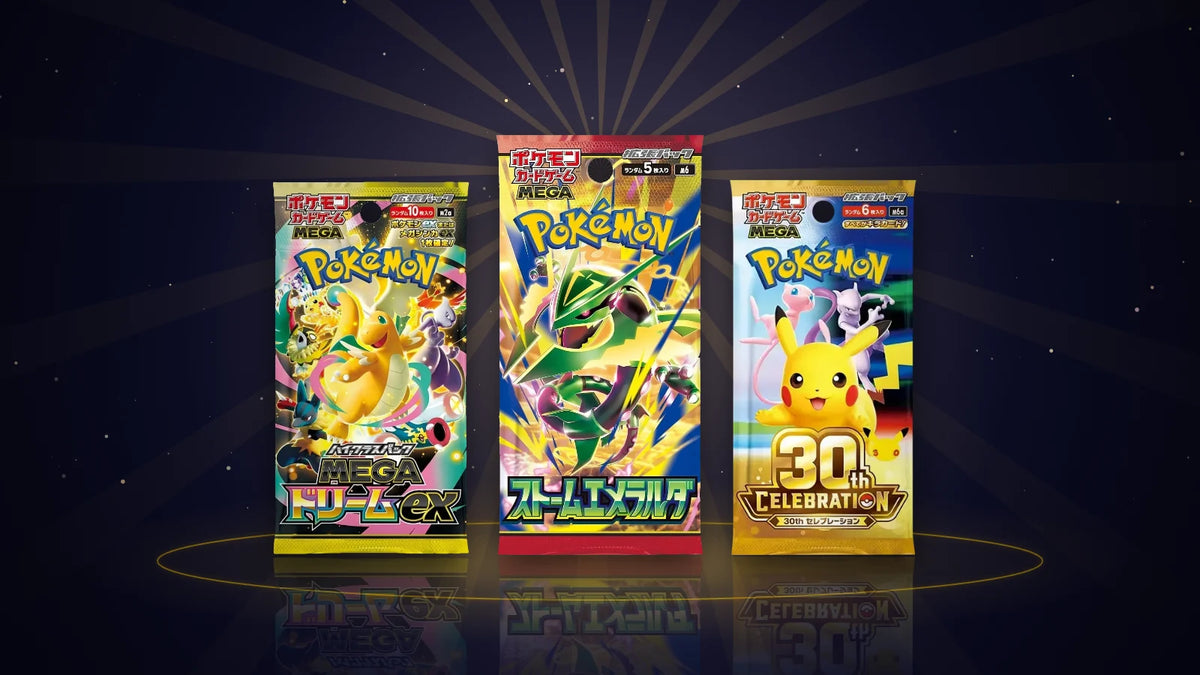
- FUR – Futuristic Rare. New in 30th CELEBRATION (M6a), with futuristic, colour-focused art. The Japanese set has two of them, Mewtwo ex 134/103 and Mew ex 135/103.
- RGB – no official name. 30th CELEBRATION also hides three unnumbered Mew cards in red, green and blue, marked R/RGB, G/RGB and B/RGB. More about them in our 30th CELEBRATION set guide.

In stock instead


Pokémon Trading Card Game5.0
30th CELEBRATION (M6a) - Booster Box (Japanese)
- 100% authentic sealed products
- Shipped within 1–2 business days
- Full refund within 14 days of delivery
- Shipping from €27,95
Older codes from Sword & Shield
Older Japanese sets use a few codes you won't find in new sets:
- RRR – Triple Rare. Pokémon VMAX and VSTAR. The code was dropped when Scarlet & Violet started in January 2023.
- HR – Hyper Rare. Rainbow cards in Sun & Moon and Sword & Shield sets.
- CHR and CSR – Character Rare and Character Super Rare. A Pokémon pictured together with its trainer. English sets used Trainer Gallery cards for the same idea.
- K – Radiant. Shining Pokémon with a special holo pattern, from 2022. On English cards: Radiant Rare.
- A – Amazing Rare. Legendary and Mythical Pokémon with a special shiny finish, from 2020. The English name is the same.
AR and SAR themselves first appeared in VSTAR Universe (S12a) in 2022 and became the standard in Scarlet & Violet.
Which rarity is the rarest?
The Pokémon Company doesn't publish pull rates for Japanese sets, so there is no official ranking. The card list shows the shape of a set, though. Storm Emeralda (M6) is a typical Mega Evolution main set: a 76-card main set, then 12 AR, 18 SR, 6 SAR and a single MUR on top. How often collectors find each of them in a box is covered in our guide to Japanese pull rates.
Rarity isn't the same as value. Condition, demand and the Pokémon or artwork on the card decide what a card is worth, and nobody can promise how a card will be valued in the future. If a card is worth protecting, read our guide to grading Japanese cards.

Pokémon Trading Card Game5.0
Storm Emeralda (M6) - Booster Box (Japanese)
In stock instead

Pokémon Trading Card Game
Aura Seeker/Hadou Seeker (M7) - Booster Box (Japanese)
How English cards show rarity
English cards print a symbol instead of a code: a circle for Common, a diamond for Uncommon and stars for the rarer cards. An Illustration Rare has one gold star, a Special Illustration Rare two and a Hyper Rare three. If you collect both languages, our guide to Japanese vs English Pokémon cards covers the other differences.
See the products
- Graded cards – including Japanese SR and SAR cards
- Japanese Pokémon cards – booster boxes and booster packs
- Pokémon singles
Frequently asked questions
What does SAR mean on a Pokémon card?
Special Art Rare. It's a Japanese rarity for a story-style illustration of a Pokémon ex or Supporter. On English cards, the same rarity is called Special Illustration Rare.
Is AR the same as Illustration Rare?
Yes. AR (Art Rare) on a Japanese card corresponds to Illustration Rare on an English card.
What is the rarest Japanese rarity?
In a Mega Evolution main set, it's usually the single MUR. Special sets add their own top rarities, like the two FUR cards in 30th CELEBRATION.
Why does my Japanese card have no rarity code?
Promo cards usually have no rarity code, and the oldest Japanese cards use the symbols ●, ◆ and ★ instead of letters.
Does a higher rarity mean a stronger card?
No. Rarity is about how often a card turns up in packs, not how good it is in a game. Many strong cards are commons and uncommons.
 5,95
 2,95
 3,95
 34,95