




A Japanese Pokémon card is worth what the same card, in the same language, version and condition, has recently sold for. There is no fixed price list, and no rule that Japanese cards are always cheaper or dearer than English ones. Below we go through what drives the value, how to check it yourself and the mistakes to avoid, and our complete guide to Japanese Pokémon cards covers the basics.
What makes a Japanese Pokémon card valuable
Five things decide most of the price, and they work together: a rare card in poor condition can be worth less than a common card that collectors want.
| Factor | What to look at | Example |
|---|---|---|
| Rarity | The rarity code next to the card number, such as AR, SAR, SR, UR or FUR | SAR (Special Art Rare) cards are secret rares, numbered above the set total, such as 201/165 |
| Condition | Centering, corners, edges and surface, and whether the card is graded | A PSA 10 can sell for several times the price of the same card ungraded |
| Version | Set code and number, first print, promo stamp, mirror pattern | Japanese 151 has mirror versions of its cards with a Poké Ball pattern |
| Demand | The Pokémon and the illustrator | Charizard, Pikachu and Eevee's evolutions, and well-known illustrators |
| Supply | Reprints and how hard a product is to buy | Popular sets are often printed again |
Our guide to Japanese rarities explains every code. Supply changes more than many expect: The Pokémon Company often prints more of a popular set, and in January 2025 it announced extra production of Terastal Festival ex and Battle Partners. That can bring prices down again after a busy release.
Japanese vs. English prices: there is no fixed rule
It is often said that Japanese cards are cheaper than English ones, but it depends on the card. These two pairs show the same Pokémon with the same artwork, as sold in Japanese and in English at the time of writing (November 2026):
| Card | Ungraded | PSA 10 | Share of PSA-graded copies that got a 10 |
|---|---|---|---|
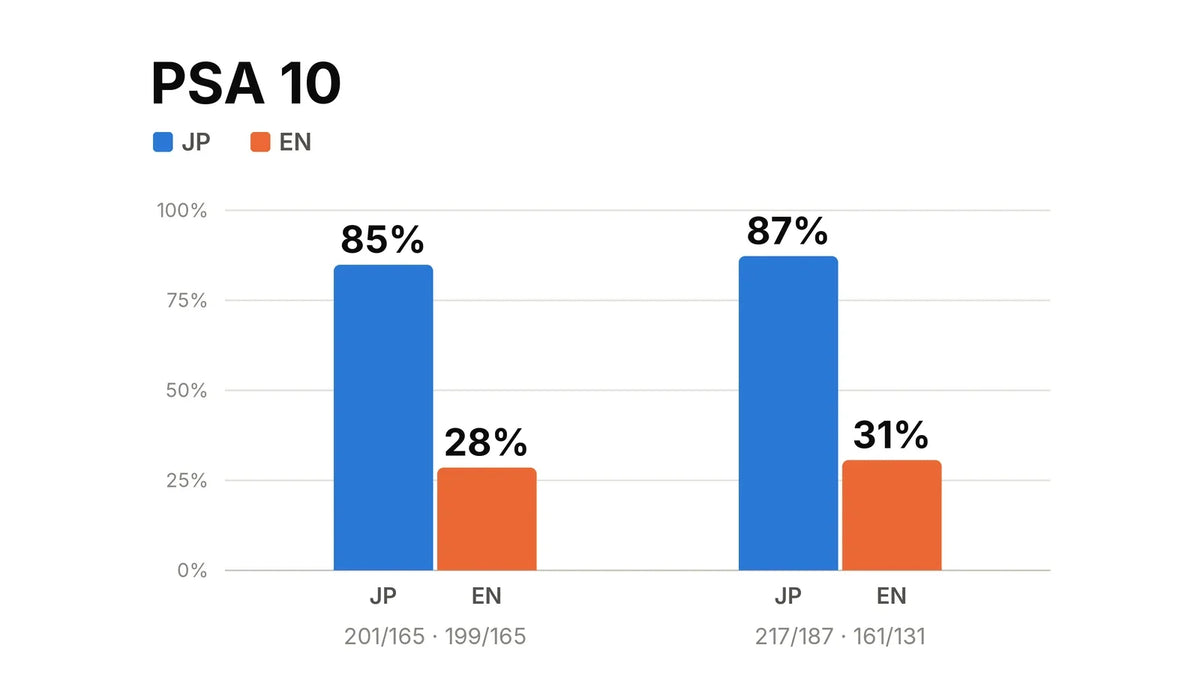
| Charizard ex: Japanese SAR 201/165, English SIR 199/165 | Japanese about 14% higher | English about 2.4 times higher | Japanese 85%, English 28% |
| Umbreon ex: Japanese SAR 217/187, English SIR 161/131 | English about 3.7 times higher | English about 10 times higher | Japanese 87%, English 31% |
The prices are based on sold listings, and the grading figures come from PSA's population report. They change all the time, so use them to understand the differences, not as today's price.
Two things help explain the gap. First, Japanese cards get a PSA 10 far more often, so a Japanese PSA 10 is less scarce. Second, demand differs between the two markets: the grading company CGC noted in December 2025 that Japanese cards have become popular as English cards get harder to afford. Our guide to Japanese vs. English Pokémon cards goes through the other differences.
How to check what your Japanese card is worth
- Identify the card exactly. On recent cards, the set code, card number and rarity code are printed at the bottom left, for example SV2a 201/165 SAR. Our guide on how to read Japanese Pokémon cards shows where to look, and the official card search lists Japanese cards with their illustrator, apart from the oldest sets.
- Look at sold prices, not asking prices. What a card has actually sold for tells you more than what sellers ask, and PSA's Auction Prices Realized collects auction results for PSA-graded cards. Compare Japanese cards with Japanese copies, not with English ones.
- Compare like with like. Same language, same number and version, same condition or grade. Use several recent sales, not a single one.
- Add the costs. If the card is in Japan, convert from yen and add shipping, VAT, customs and fees. Our guide to buying Japanese Pokémon cards in Europe explains them.
When we price cards ourselves, we only compare with sales of the same card in the same language. A Korean or English copy tells you nothing about what the Japanese one is worth.
Raw or graded: what a PSA 10 means for Japanese cards
Because Japanese cards so often reach a PSA 10, the jump from an ungraded copy is smaller: in the two pairs above, a PSA 10 was valued at about 1.5 to 1.6 times the ungraded price for the Japanese cards, against about 4 times for the English cards. Our guide to grading Japanese Pokémon cards compares PSA, BGS and CGC.
The label is the first thing to check on a graded card. It names the set, the language, the card number and the grade, and it should match what is printed on the card itself. Our Gwynn SAR (117/081) slab says JAPANESE and our Lugia V SR (110/098) says KOREAN, which puts each card in its own market. Always look up the certification number on the grader's website too, for example with PSA's cert lookup, because PSA calls its holder tamper-evident, not tamper-proof.

(1) The label names the year, the set, the language and the card number. (2) The grade. (3) The set code, card number and rarity printed on the card itself.


Pokémon Trading Card Game
Lugia V Alt Art SR 110/098 - Paradigm Trigger (S12) - BGS 9 Mint (Korean)
- 100% authentic sealed products
- Shipped within 1–2 business days
- Full refund within 14 days of delivery
- Shipping from €27,95
Common mistakes when valuing Japanese cards
- Mixing languages. At the time of writing, the Korean Charizard ex with the number 201/165 sells for about a third less than the Japanese one, and Chinese and English versions have their own prices too.
- The wrong number or version. The Japanese Charizard ex SAR from Pokémon Card 151 (SV2a) is 201/165, the English one 199/165. At the time of writing, an ungraded Japanese Base Set Charizard from the first print, which has no rarity symbol, is valued at more than 40 times the later print, though it only sells a few times a year.
- Comparing raw with graded. A graded price says nothing about an ungraded copy, and the other way round.
- Asking prices and release-week prices. The Pokémon Company itself warns that flea-market prices can spike right after a release.
- Fakes and searched packs. The Pokémon Company warns about replica cards, counterfeit goods and searched packs and boxes sold online. Our guide to spotting a fake or resealed Japanese booster box shows what to look for.
- Forgetting the exchange rate and import costs. A low price in yen can end up higher than a European price once everything is added.
Sealed Japanese boxes: what affects their price
A sealed box is valued like a single card: compare the same set, the same language and the same condition. Boxes differ more than you might think. Most Japanese boxes hold 30 packs of 5 cards, while MEGA Dream ex (M2a) holds 10 packs of 10 cards and 30th CELEBRATION (M6a) holds 20 packs of 6 foil cards. Our guide to what's inside a Japanese booster box lists the formats.

In stock instead


Pokémon Trading Card Game5.0
30th CELEBRATION (M6a) - Booster Box (Japanese)
The shrink matters too: buyers treat a box with intact shrink and one without as two different products. We have also sold boxes without shrink, and when we do, it says so clearly on the product. Our guide to shrink vs. no shrink Japanese booster boxes explains why. A reprint can push prices down again, and we don't give investment advice: nobody knows how a sealed box will be valued in a few years.
See the products
To open lots of packs
Pokémon Trading Card Game5.0
30th CELEBRATION (M6a) - Booster Box (Japanese)
Frequently asked questions
Are Japanese Pokémon cards worth anything?
Yes. Most common cards are worth little, but rare cards in good condition can be worth a lot. The most expensive Pokémon card ever sold is Japanese: a PSA 10 Pikachu Illustrator, a 1998 contest prize that was never sold in shops, went for $16,492,000 in February 2026, according to Guinness World Records.
Are Japanese Pokémon cards worth more than English ones?
It depends on the card. In our examples, the ungraded Japanese Charizard ex was the dearer one, while the English Umbreon ex cost several times more than the Japanese. In PSA 10, the English cards were the dearest in both pairs.
Why are Japanese Pokémon cards often cheaper?
Partly because Japanese PSA 10s are far more common, which keeps graded prices lower, and partly because demand differs: CGC noted in December 2025 that Japanese cards have become popular as English cards get harder to afford. It is not a rule, so check each card.
How do I find out what my Japanese card is worth?
On recent cards, find the set code, card number and rarity at the bottom left, then compare recent sold prices of the same card in Japanese, in the same condition or grade.
Do Japanese cards get a PSA 10 more easily?
The figures suggest so: in our examples, 85 to 87% of the Japanese copies PSA graded got a 10, against 28 to 31% of the English ones. Only cards that people send in are counted, though, and people may send in only their best copies.
 5,95
 2,95
 3,95
 34,95